
Department 06 — of 07
Academic Support
Program.
The same rigorous curriculum, five students at a time — support that builds independence.
Overview
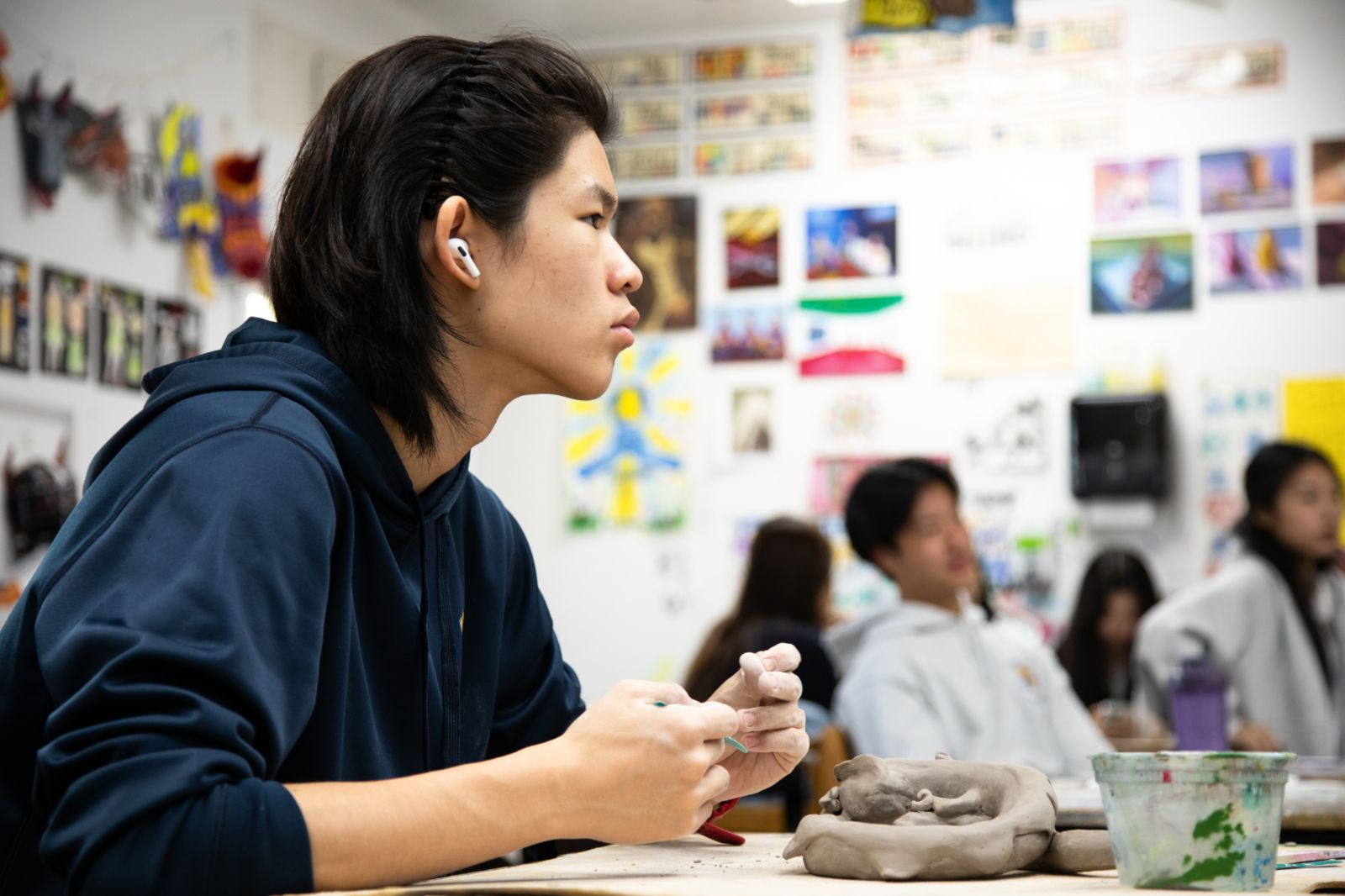
The Storm King School's Academic Support Program is built on a simple conviction: students with identified learning differences don't need a different curriculum — they need a different classroom. ASP courses follow the same rigorous college-preparatory curriculum as the School's traditional classes, taught by teachers trained in learning differences, in classes that average just five students. Individualized attention, organizational strategies, and flexible pedagogy do the rest — building the academic confidence and performance that carry students back into traditional classes, and on to college.
Enrollment begins with the non-credit ASP Base class, where students are coached in organization, time management, and self-advocacy while their teacher coordinates with every other teacher they have. From there, students may take ASP core classes in math, English, science, and history — and as their skills develop, they evolve toward more traditional classes and fewer ASP ones. Every ASP student also has full access to the School's traditional electives, including 21 Advanced and AP courses.
Courses
Base
Enrollment in the Academic Support Program starts with the non-credit ASP Base class. The ASP Base class teacher coaches students in organization, time management, breaking assignments down into manageable components, and following through to make sure that they are completed in a timely manner. Students practice effective strategies such as routine use of planners, backpack organization, communicating with subject area teachers to build self-advocacy skills, arranging study areas for maximum result, and more. Each student learns his/ her own strengths as learners, and strategies to help him/ her succeed. The ASP teacher coordinates with all of the student’s other teachers, observing the student in other classes if warranted, and providing insights and tips. Students who are enrolled in the Academic Support Program Base class are eligible to enroll in Academic Support Program core classes, which are subject area classes in math, English, science and history/social sciences. These classes have curriculum similar to those of traditional classes, but are smaller in size, usually with a maximum of five students. Academic Support Program teachers are trained and experienced in working with students who have identified learning differences. For example, a student with a language-based learning difference might take ASP US Studies Literature and ASP Government class. Students may begin with full ASP (Base class plus four core classes) as well as traditional electives and activities. As they develop skills, they may evolve to take more traditional classes and fewer Academic Support Program classes.
Algebra I
ASP Algebra I is the foundational high school mathematics course. It is the connection between the concrete to the abstract study of mathematics. Topics include simplifying expressions, evaluating and solving equations and inequalities, and graphing linear and quadratic functions, relations, and equations. Real world applications are presented within the course content.
Geometry
This course includes an in-depth analysis of plane, solid, and coordinate geometry as they relate to diverse mathematical concepts. Topics include logic and proof, parallel lines, polygons, perimeter and area analysis, similarity and congruence, and applications to real life situations. Emphasis will be placed on developing critical thinking skills as they relate to logical reasoning and argument. Students will be required to use different types of reasoning and explanation to discover much of the course content. Additionally, students will be required to construct project material outside of the classroom. The nature of the course is designed to expand the students’ ability in explaining the steps they took to solve a problem.
Algebra II
Basic mathematical skills and the logical approach they teach are essential to a student’s ability to interpret data and gain predictive and generalized meaning from raw observation. Mastery of these basic skills will give the student the confidence and desire to investigate the world of higher math. Students will expand skills learned in Algebra and will study higher-level skills such as rational expressions, radical equations, imaginary numbers, solving quadratics, transforming functions, and conic sections. Algebra II is the prerequisite to Precalculus.
Precalculus
Topics in Precalculus include advanced subjects in algebra, geometry, trigonometry, and other areas of mathematics. In addition to forming the foundation for the study of calculus, the topics covered in this class have wide-ranging applications in science, art, engineering, architecture, navigation, and many other areas. Literally “measuring triangles,” trigonometry builds on foundations of geometry and algebra to form powerful tools of analysis and modeling. Developed independently in several cultures, trigonometry most likely provided tools to astronomers and engineers of the ancient world. Today, its applications range from astrophysics to acoustics, spanning across virtually every field of science and engineering. From exponential to power functions, logistic functions to sinusoids, this course will give students the tools they need to analyze a function in a multiple of ways. We will be using a graphing calculator heavily in this course. Precalculus is the prerequisite for Calculus.
Freshman Physics
In ASP Freshman Physics, students are introduced to the fundamentals of physical science and the natural world using age-appropriate mathematical tools. Topics include measurement, kinematics, forces, momentum, energy, electricity and magnetism, gravity, and more as time permits. In addition to learning about these areas of physics, students are guided to develop their skills in experimental design, analysis, and reflection, which lead to the construction of scientific models that ultimately allow students to make predictions and develop a more nuanced understanding of the natural phenomena.
Chemistry
ASP Chemistry is the study of matter, energy, and their interactions. This course covers chemistry’s basic principles, including atomic theory, the periodic table, chemical reactions, chemical quantities, chemical names with formulas, stoichiometry, and ionic/covalent bonding. This course is structured to develop critical thinking as well as independent and group problem-solving skills. Laboratory safety and techniques are emphasized in all experimental activities.
Physics
The scientific field of physics has been central in the development of modern civilization, from everyday conveniences to advanced technologies to our understanding of our place in the Universe, and it will continue to lead us to discoveries yet to be imagined. This physics course follows a modeling approach in which the students actively participate in the process of scientific inquiry. Major concepts are introduced with paradigm labs in which students measure observable quantities, extract key relationships between the variables, and develop models to understand the observed phenomena. Multiple representations—schematic, graphical, and mathematical—are developed, which together define the models. Students regularly work in teams, and both present and defend their work amongst each other. The curriculum includes kinematics, dynamics, energy, and other topics as time permits.
Introduction to Literature
Anchored in Perrine’s anthology titled Literature: Structure, Sound and Sense, this course explores a variety of world literature in an array of historical contexts. Students will build on their skills of literary analysis, class discussion, basic literary terminology, and their ability to appreciate literature. In addition, the writing component of the course will introduce expository essay writing, literary analysis, argumentative essays, and personal memoirs.
US Studies Literature
This survey of the classic works of the American Literary tradition strides through several key time periods, beginning in pre-Columbian times with Native American mythology and ending in Arthur Miller’s modern existential drama, Death of a Salesman. Additional centerpieces for this class include The Scarlet Letter, Adventures of Huckleberry Finn, Narrative of Frederick Douglas, an American Slave, and The Great Gatsby. This course includes a substantial research project and several literary analysis essays. New students in grade eleven or twelve who have not taken American Literature may opt to take this course.
Fundamentals of English I
ASP Fundamentals of English I is a comprehensive course of literature, composition, vocabulary and grammar as well as practice using expressive and receptive language skills. Personalized instruction, metacognitive strategies, and specific organizational tools are all integrated into the learning process for each student. Specific focus will be placed on understanding and identifying literary devices. Moreover, students will work on writing skills with a focus on structural organization and planning. Students will also strengthen and expand vocabulary skills with Wordly Wise, a program which uses a variety of different activities towards vocabulary development. Possible novels include To Kill a Mockingbird by Harper Lee, The Giver by Lois Lowry, and Night by Elie Wiesel.
Fundamentals of English II
ASP Fundamentals of English II is a comprehensive course of literature, composition, vocabulary and grammar, as well as practice using expressive and receptive language skills. Personalized instruction, metacognitive strategies, and specific organizational tools are all integrated into the learning process for each student. Specific focus will be placed on understanding and identifying literary devices. Moreover, students will work on writing skills with a focus on structural organization and planning. Students will also strengthen and expand vocabulary skills with Wordly Wise, a program which uses a variety of different activities towards vocabulary development. Possible readings include The Great Gatsby, The Old Man and The Sea, and Shakespeare’s Macbeth.
Global Studies History
In this required ninth grade course, students explore the cultures and history of people across the globe, from the beginning of human development through ancient civilizations and the Middle Ages. By understanding the common struggles and achievements of past people, students better understand the shortcomings and successes of our current age. Along with studying history chronologically, we will focus on several themes that have impacted the course of human culture and civilization, including colonization and empire-building, different political systems, and technology. We will also look at many of the more day-to-day aspects of life such as family, religion, and food that have changed over time.
US Studies History
Offered to sophomores, this course will review the important events and key issues related to U.S. history. Topics covered include the birth of the new nation, the Civil War, diversity and equality, government, and foreign policy. The Storm King School takes advantage of its historical location along the iconic Hudson River to further the students’ exploration of history with resources such as the Black Rock Forest Preserve, West Point, the FDR museum, Washington’s Headquarters, and Fort Montgomery, and many others.
Psychology
Psychology is a field of study with a wide range of applications. This course is designed to introduce students to the core principles of the discipline. It will provide a framework for the exploration of a variety of topics including but not limited to social influences on human behavior, the causes and treatments of various mental illnesses, personality traits and their roots in our development, and the long-term impact of prolonged stress. Students will have the opportunity to engage in cooperative projects wherein they will design and conduct their own psychological experiments using techniques they learn in class. By the end of the semester, students who take this course will be able to create detailed diagrams of the brain, recognize the stages of general adaptation syndrome in their own stress response, apply attribution theory in their daily lives, and much more.
Comparative Government
This course examines American as well as other government systems and ideas of government and justice systems around the world, not only from a traditional teaching perspective, but also from the knowledge of students who come from other countries explaining their cultures. The class spends quite a bit of time on different constitutions, but pays particular attention to the American Constitution. Students are eager to act as members of the “Supreme Court,” assessing whether or not they come to the same decisions and why.
Faculty
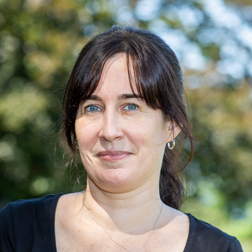
Heather Cosgriff
Director of the Academic Support Program
ASP Teacher
B.A., Psychology, Bryn Mawr College; M.A., Applied Educational Psychology — Reading Specialist, Teachers College, Columbia University
Read bio
Heather Cosgriff earned a BA in Psychology from Bryn Mawr College, followed by an MA in Applied Educational Psychology from Teachers College at Columbia University. Prior to joining the Storm King community, she worked in independent schools in Pennsylvania and New Jersey as a reading specialist, learning specialist, and director of learning support. In the Academic Support Program, Ms. Cosgriff supports students as they strengthen executive functions, practice self-advocacy skills, and become more confident and independent learners.
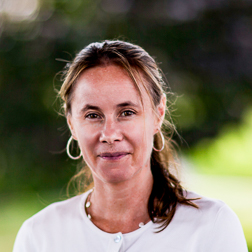
Lisa Shrem
ASP Teacher
History & Social Sciences · Co-Director, Community Service
M.Ed., Special Education, Hunter College
Read bio
Lisa Shrem has over 12 years of experience teaching a variety of subjects to students with learning differences using a differentiated approach, with extensive training in multi-sensory tactics, whole language, behavior modification, and Orton-Gillingham. She recently earned a Certificate in Learning Differences and Neurodiversity from Landmark College. Specializing in executive function disorders and learning disabilities, she also co-directs the School's community service program. Off campus, she enjoys time with her three children, running, and hiking with her dogs.
Every course, every department, one program.
Explore All Academics