Academics — World Languages
World Languages
Spanish and American Sign Language — with equal emphasis on reading, writing, speaking, and listening at every level.
No. 01 — The Department
Four skills, many worlds.
In the World Languages curriculum, equal emphasis is placed on the four major components of language learning: reading, writing, speaking, and listening.
First and second-level courses stress rapid acquisition of vocabulary, fundamental grammatical skills, and cultural awareness. Third-level courses provide a comprehensive review of grammatical structures and an introduction to reading and composition. Fourth-level courses are usually devoted to the development of oral proficiency and literary skills.
No. 02 — Course of Study
Two languages, every level.
This course gives students a command of basic Spanish grammar and language structure as well as knowledge of a variety of Hispanic cultures. The class is also designed to give ample practice in the five important skill areas of learning a language: speaking, listening comprehension, reading, and writing. Students will enhance their command of the Spanish language through listening exercises, homework, quizzes, tests, and short writing and reading assignments. In addition, activities will expand understanding of Hispanic cultures through Spanish language films and music, group projects, and current news from the Spanish speaking world.
This course builds upon basic Spanish grammar and language structures as well as knowledge of a variety of Hispanic cultures. The class is also designed to continue students’ practice in the five important skill areas in learning a language: speaking, listening comprehension, reading, and writing. Students will enhance their command of the Spanish language through listening exercises, homework, quizzes, tests, and short writing and reading assignments. Also, activities will expand understanding of Hispanic cultures through Spanish language films and music, group projects, and current news from the Spanish speaking world.
This course is meant to improve student proficiency in Spanish and advance command of grammar and language structures as well as knowledge of a variety of Hispanic cultures. The class is also designed to further enhance the four important skill areas in learning a language: speaking, listening comprehension, reading, and writing. Students will improve their command of the Spanish language through listening exercises, homework, quizzes and tests, and short writing and reading assignments. Also, activities will expand understanding of Hispanic cultures through Spanish language films and music as well as cultural projects.
AP Spanish Language and Culture is equivalent to an intermediate level college course in Spanish. Students cultivate their understanding of Spanish language and culture by applying interpersonal, interpretive, and presentational modes of communication in real-life situations as they explore concepts related to family and communities, personal and public identities, beauty and aesthetics, science and technology, contemporary life, and global challenges.
Many students become interested in American Sign Language (ASL) because they favor a less traditional kind of language and way of learning a language. As an interactive, visual-spatial language with all the complexity and nuance of a written language but without a current written component, ASL offers a unique language-learning experience. This course introduces students to American Sign Language and Deaf Culture. Within this class, students will learn and develop fluency with fingerspelling while learning basic vocabulary and simple expressions. They will also be exposed to various aspects of Deaf Culture, including background and historical perspectives, as well as discussion surrounding the deaf community today.
This course focuses on communication utilizing ASL. Students will use the Signing Naturally Curriculum to build upon receptive and expressive signing and fingerspelling skills learned previously in ASL I. Of particular focus will be enhancing competency with sign vocabulary and grammatical syntax. As with any language, the study of culture and history is also included. Emphasis is placed on continuing to think in pictures and building (production and comprehension) communication skills.
This course builds on the proficiency level that was achieved in ASL II. Within this class, students utilize their vocabulary and fingerspelling base to begin communicating in simple ASL grammatical structures. Students practice both their receptive and expressive skills in pairs, small groups, as well as in full class exercises. Equally important while learning effective communication is the expansion of knowledge regarding Deaf history and culture. Students gain an appreciation for important events and significant individuals’ contributions to history. In addition, new technology and its impact upon the deaf community is explored.
This course assumes ASL proficiency, and as such, employs a “voices off” policy in every class. Students communicate through signing only as their signing proficiency increases. There will be a number of hands-on activities where students learn greater appreciation for Deaf culture as they navigate the real world using ASL alone.
No. 03 — Faculty
The people behind the courses.


No. 04 — Visit Us
Say hello — in any language.
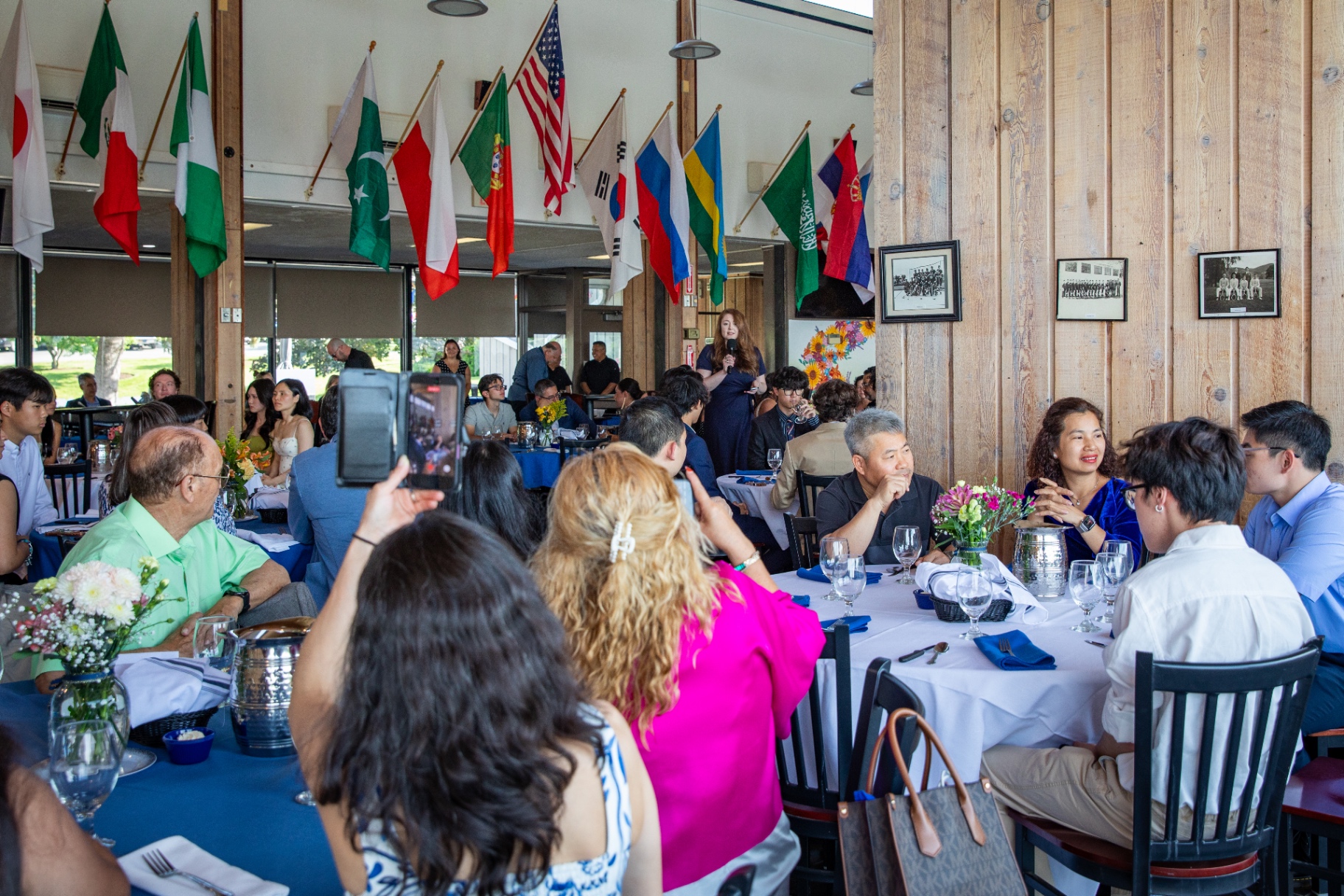
With students from around the world, Storm King is a place where languages live. We invite prospective students and their families to visit campus and experience it.
Explore Admissions