
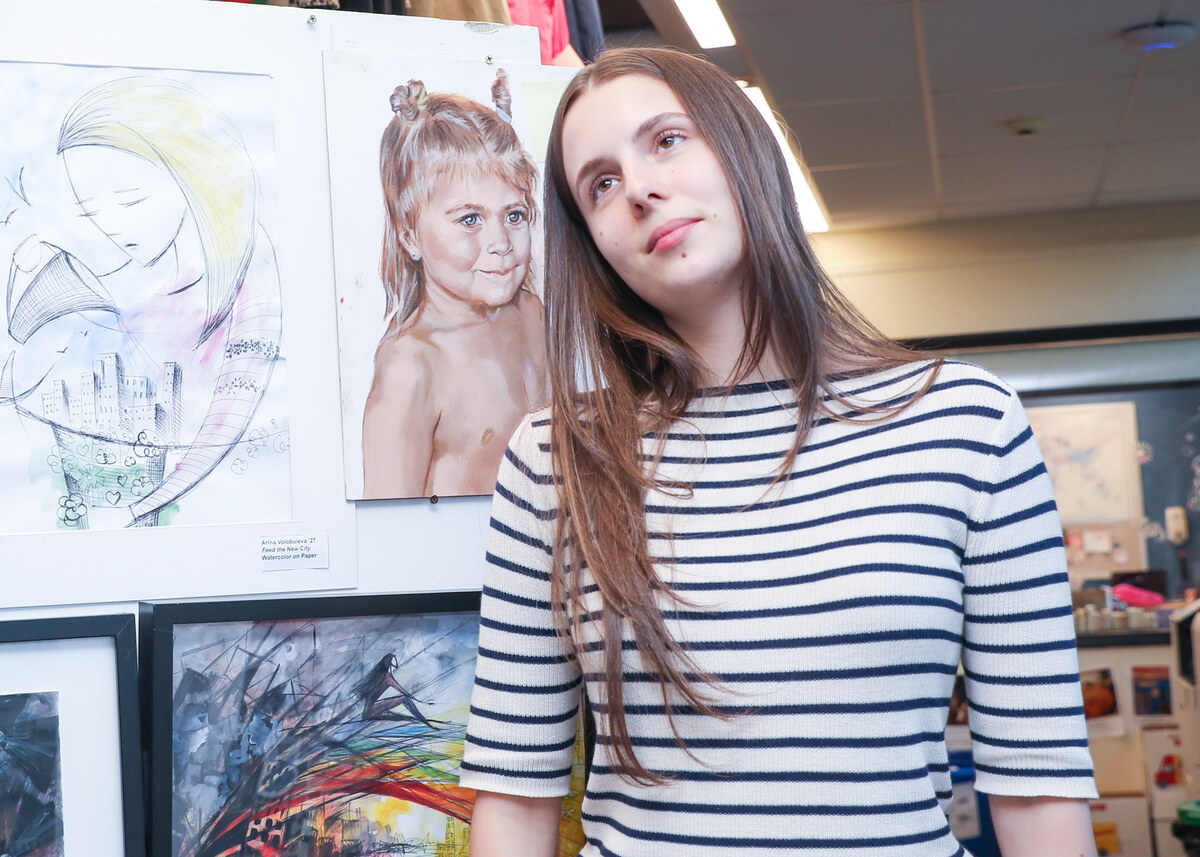
What if a painting could tell you that a crisis was coming? That question became the starting point for Storm King senior Arina V. ’27’s interdisciplinary independent study, an ambitious project that brought together two subjects that are rarely studied side by side: art and economics.
Working with Storm King’s Visual Arts Chair John Carruthers and History and Social Sciences teacher Rushdi Siddiqui, Arina set out to explore whether measurable changes in artistic production could precede institutional and economic crises by one to five years.
The result is an 8,000-word research paper, “The Black Box of Civilization: Art as a Mechanism of National Identity, Economic Resilience, and Psychological Survival.”
According to Arina, her interest in the question grew from two very different parts of her experience at The Storm King School. “I have been fascinated by painting since childhood, when I copied works by artists including Egon Schiele, Ilya Repin, and Henri de Toulouse-Lautrec to study their techniques and brushstrokes. At Storm King, Mr. Siddiqui’s Advanced Microeconomics course introduced me to a new way of thinking about markets, systems, and economic behavior.”
That is when Arina began wondering whether the two fields might intersect. Could something as subjective as a painting be analyzed quantitatively?
Data and Art
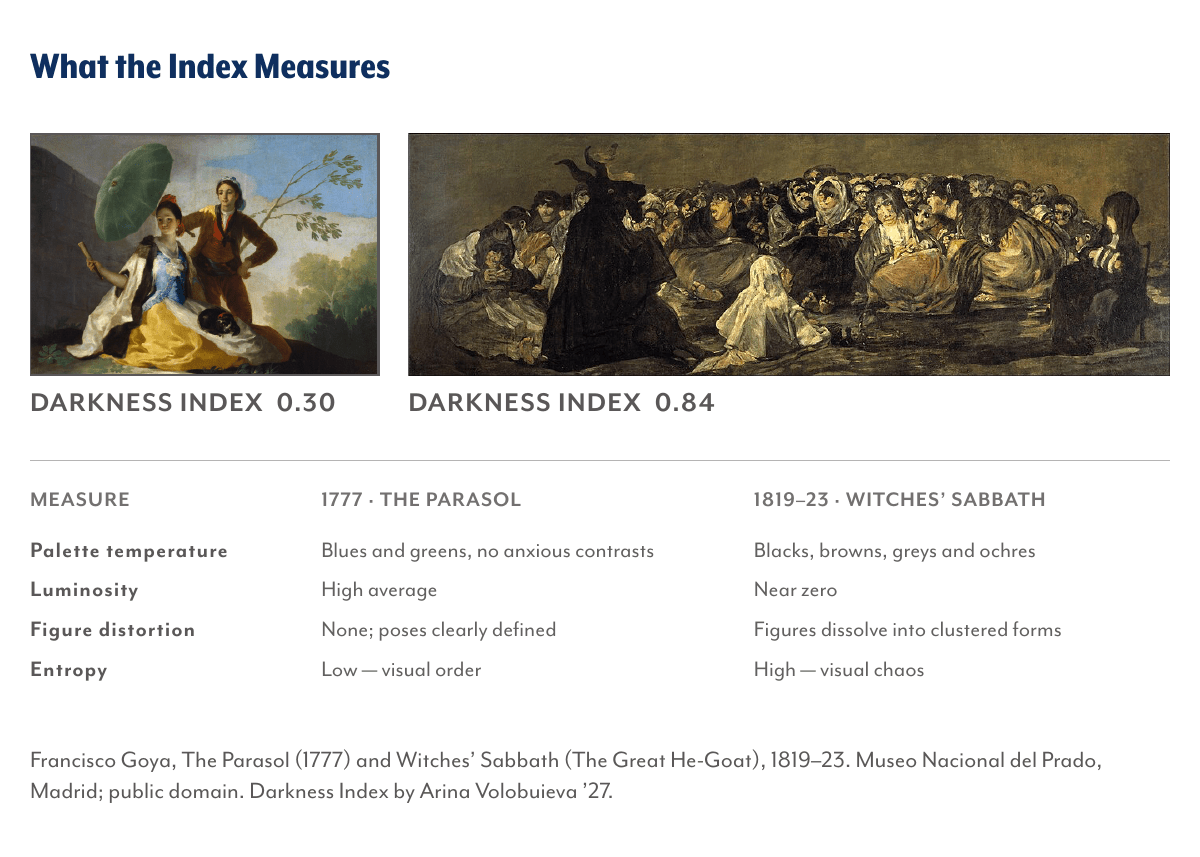
To investigate this question, Arina developed a methodology she called the Darkness Index.
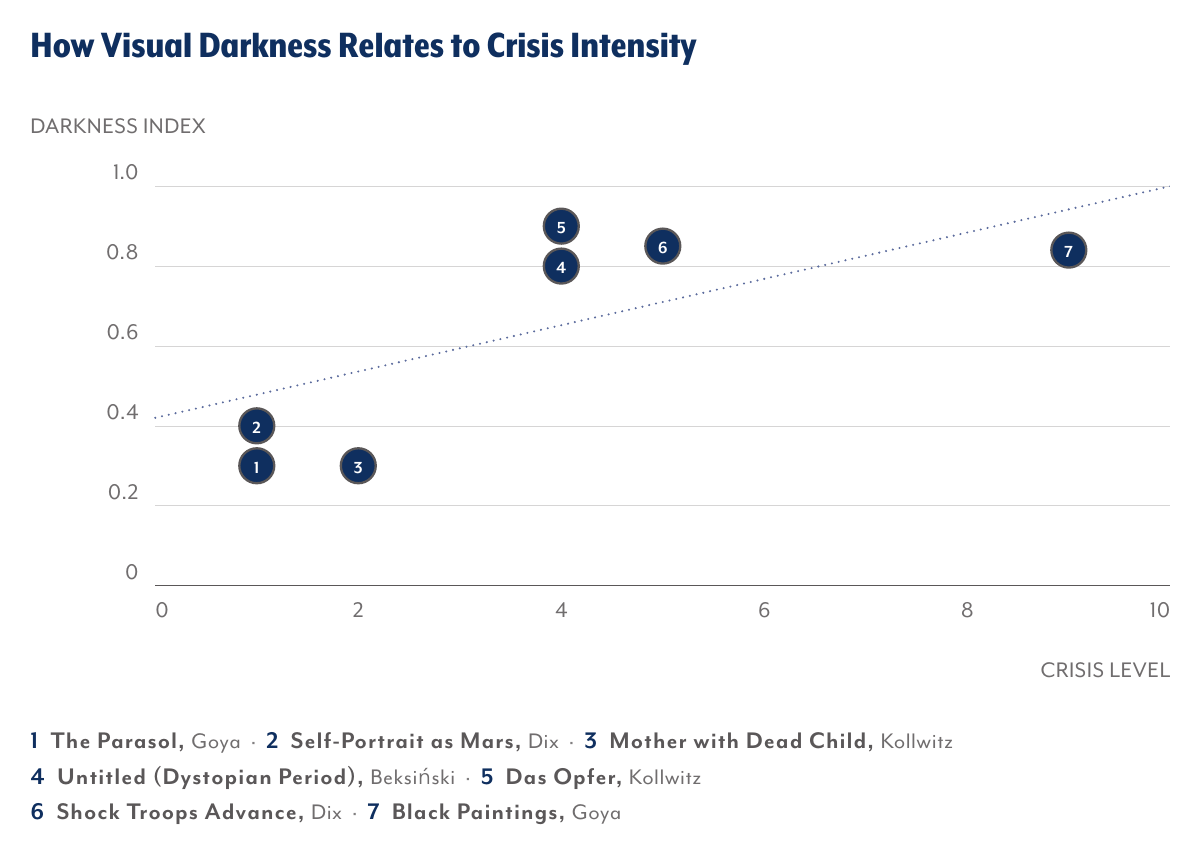
Rather than simply describing a painting as dark or light, she assigned each work a numerical score from 0 to 10 based on four visual characteristics: luminosity, figure distortion, palette temperature, and entropy. She then tracked the scores across the work of four artists—Francisco Goya, Otto Dix, Käthe Kollwitz, and Zdzisław Beksiński—and compared them with periods of social, political, and economic upheaval.
The patterns she found were striking. Goya’s increasingly dark and fragmented work corresponded with the upheaval surrounding the Napoleonic invasion of Spain. Otto Dix’s most powerful artistic response to the trauma of World War I emerged years after the war, suggesting that artistic responses to collective trauma can sometimes be delayed. Kollwitz’s work provided another variation, indicating that the visual response may differ depending on whether a crisis is chronic or acute.
In several of the historical cases she examined, Arina found that changes in artistic expression appeared to precede or accompany documented crises. Her findings are preliminary rather than definitive, but they point toward an intriguing possibility: that art may register changes in a society before those changes become fully visible in conventional economic data.
Art as a “Black Box”
One of the ideas that shaped Arina’s thinking came from an unexpected historical example. “During the Siege of Leningrad, residents burned furniture, floorboards, books, and other possessions for warmth and survival. But paintings were often preserved even as conditions became desperate,” explained Arina. “I became interested in the contradiction: if art were simply a luxury commodity, why would people protect it when its practical value was almost nonexistent?”
Her answer is central to her paper. Art can function as a repository of cultural memory, identity, and shared history—a kind of civilizational “Black Box.” Even when an artwork has little immediate practical utility, its symbolic value can become especially important when the systems around it are under threat.
That idea allowed Arina to connect the creative and analytical sides of her education. “Economics gave me a framework for thinking about value and systemic instability; art gave me a way to examine how people and societies respond to those forces,” Arina continued.
Learning Through the Process
The independent study also gave Arina the opportunity to experience her research as an iterative process. After pitching the idea to Mr. Siddiqui and Mr. Carruthers and receiving approval, she conducted extensive research before writing the paper. Mr. Siddiqui reviewed her draft and returned it with questions that pushed her to strengthen the argument, while Mr. Carruthers reviewed the art-historical sections for accuracy and credibility.
Arina eventually realized that her paper needed more than text to communicate the research effectively. “I taught myself to use Excel to organize and visualize my data, turning my Darkness Index scores into charts that helped me see the patterns in a new way,” she commented. “It was exciting to actually see my numbers become charts.”
Along the way, Arina also developed skills in data collection, organization, visualization, research, analysis, citation, and evidence-based argumentation. She will also explore having her paper published. But perhaps the most important lesson was a personal one. “It was proof that I didn’t have to choose between the creative side of me and the analytical side,” Arina says.
The independent study gave Arina the opportunity to investigate a question that did not have a ready-made answer. In the process, she developed her own methodology, worked with data, and brought together two areas of study that initially seemed far apart—a good example of what can happen when a student has the freedom to pursue a question across disciplines.
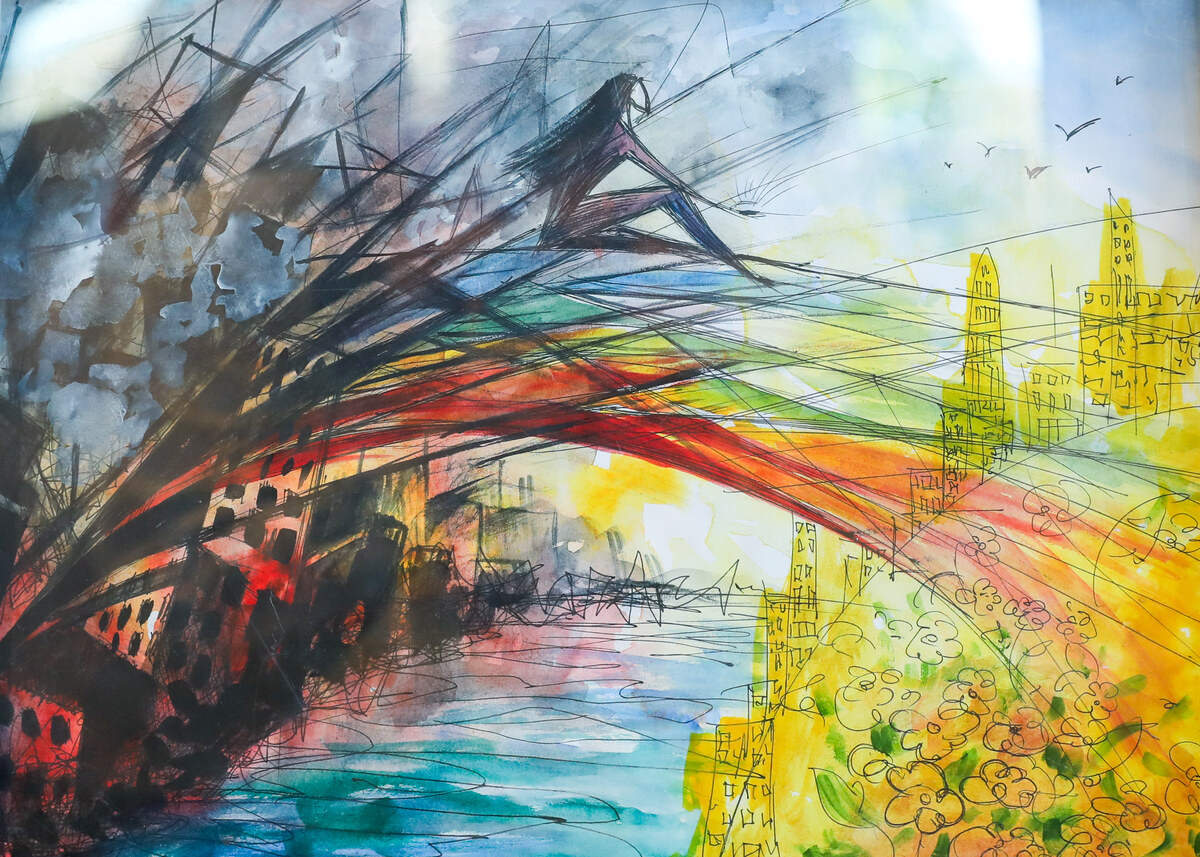
“Bridge to Light,” watercolor by Arina V. ’27.
